APOD on Nostr: **Astronomy Picture of the Day** 19 March 2026 **Cygnus and the Solitary Tree** Image ...
**Astronomy Picture of the Day**
19 March 2026
**Cygnus and the Solitary Tree**
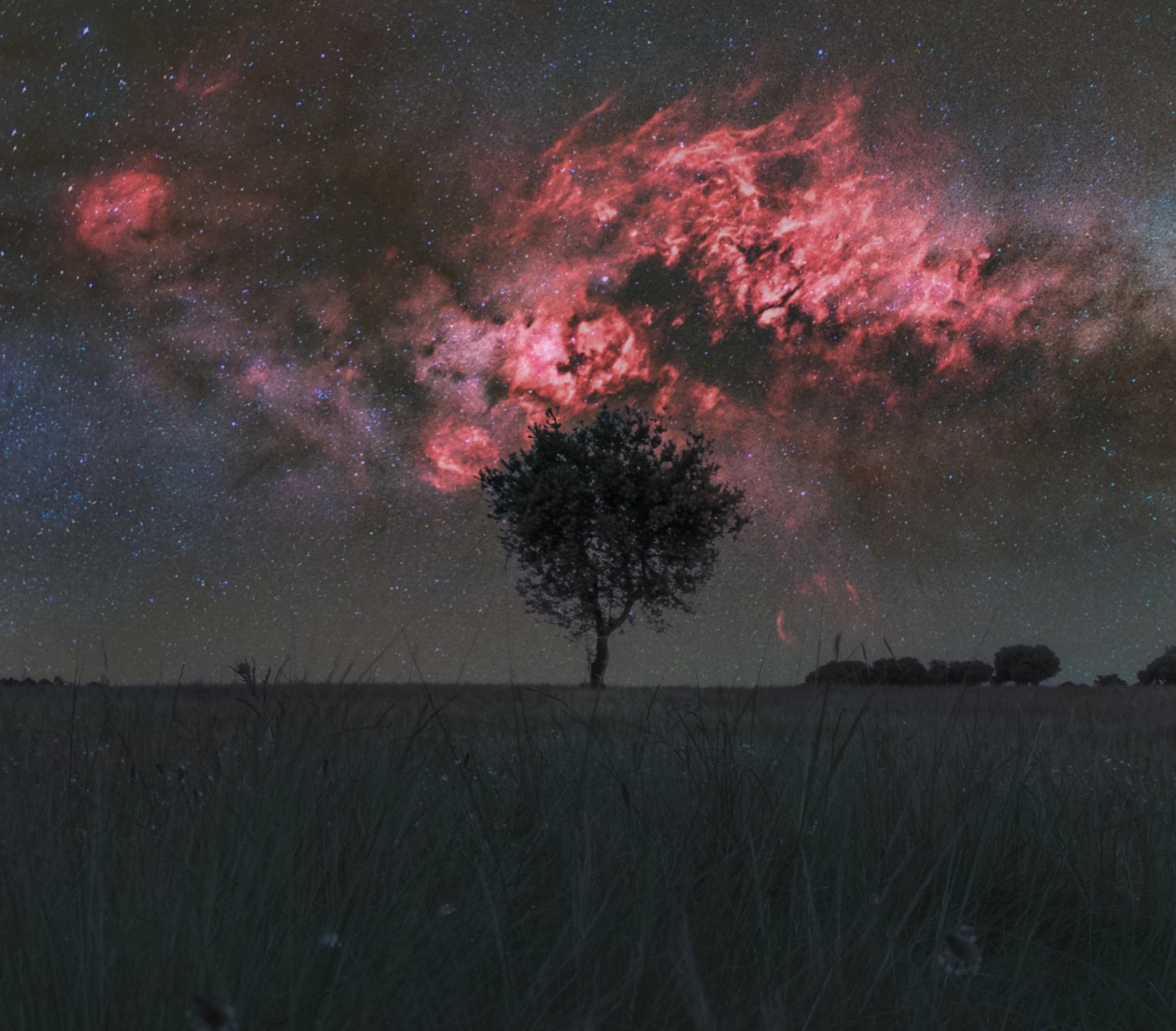
Image Credit: AstroHoracio, Keighley Rockcliffe, NASA, GSFC, UMBC CSST, CRESST II
Explanation:
A lone tree stands in a quiet meadow in
Guadalajara, Spain,
silhouetted against
the Cygnus region
rising above like flames in the night sky.
This deep night skyscape is a composite of exposures that reveals a range of brightness and color human eyes can't quite see on their own.
Spanning over a thousand times the
angular size
of the full moon,
Cygnus
sets the sky afire with
active star formation
where clouds of gas and dust collapse under gravity until
nuclear fusion
ignites and new stars are born.
These stars
ionize
the surrounding hydrogen gas, causing it to
glow crimson,
while tendrils of
interstellar dust
absorb some of that light and cast dark shadows across the sky.
Cygnus is a trove of celestial treasures, notably the
Veil,
Crescent, and
Pelican nebulae,
as well as
Cygnus X-1,
the first confirmed
black hole.
Cygnus continues to yield fresh science, including
a new three-dimensional model
of the
Cygnus Loop
made possible by
the Chandra X-ray Observatory.
#APOD #Cygnus #CygnusRegion #VeilNebula #PelicanNebula #CrescentNebula
https://apod.nasa.gov/apod/ap260318.htmlPublished at
2026-03-19 04:12:04 UTCEvent JSON
{
"id": "d14fa1060a3925ef7ad94b3cab17dcea023034a860d9aa623e06b1a3282eb8ce",
"pubkey": "e85ed75286cb77475776c1007df8c4ff1c9c68eff91c3627347b065c5bf4dc78",
"created_at": 1773893524,
"kind": 1,
"tags": [],
"content": "**Astronomy Picture of the Day**\n\n19 March 2026\n\n**Cygnus and the Solitary Tree**\n\nhttps://apod.nasa.gov/apod/image/2603/cygnus_tree_crop.jpg\n\nImage Credit: AstroHoracio, Keighley Rockcliffe, NASA, GSFC, UMBC CSST, CRESST II\n\nExplanation: \n\nA lone tree stands in a quiet meadow in \nGuadalajara, Spain,\nsilhouetted against \nthe Cygnus region \nrising above like flames in the night sky. \n\nThis deep night skyscape is a composite of exposures that reveals a range of brightness and color human eyes can't quite see on their own.\n\nSpanning over a thousand times the \nangular size \nof the full moon, \nCygnus\nsets the sky afire with \nactive star formation\nwhere clouds of gas and dust collapse under gravity until \nnuclear fusion \nignites and new stars are born.\n\nThese stars \nionize \nthe surrounding hydrogen gas, causing it to\nglow crimson, \nwhile tendrils of \ninterstellar dust \nabsorb some of that light and cast dark shadows across the sky.\n\nCygnus is a trove of celestial treasures, notably the \nVeil, \nCrescent, and \nPelican nebulae, \nas well as \nCygnus X-1, \nthe first confirmed \nblack hole. \n\nCygnus continues to yield fresh science, including \na new three-dimensional model \nof the \nCygnus Loop \nmade possible by \nthe Chandra X-ray Observatory.\n\n#APOD #Cygnus #CygnusRegion #VeilNebula #PelicanNebula #CrescentNebula\n\nhttps://apod.nasa.gov/apod/ap260318.html\n",
"sig": "655eb1578ec09d671022d0c566a2aad7079501af3de8fea701f0313779c2e6524138c16567f4000eab559f1703586f7fc141be707d168d20b12a5604d8766086"
}
