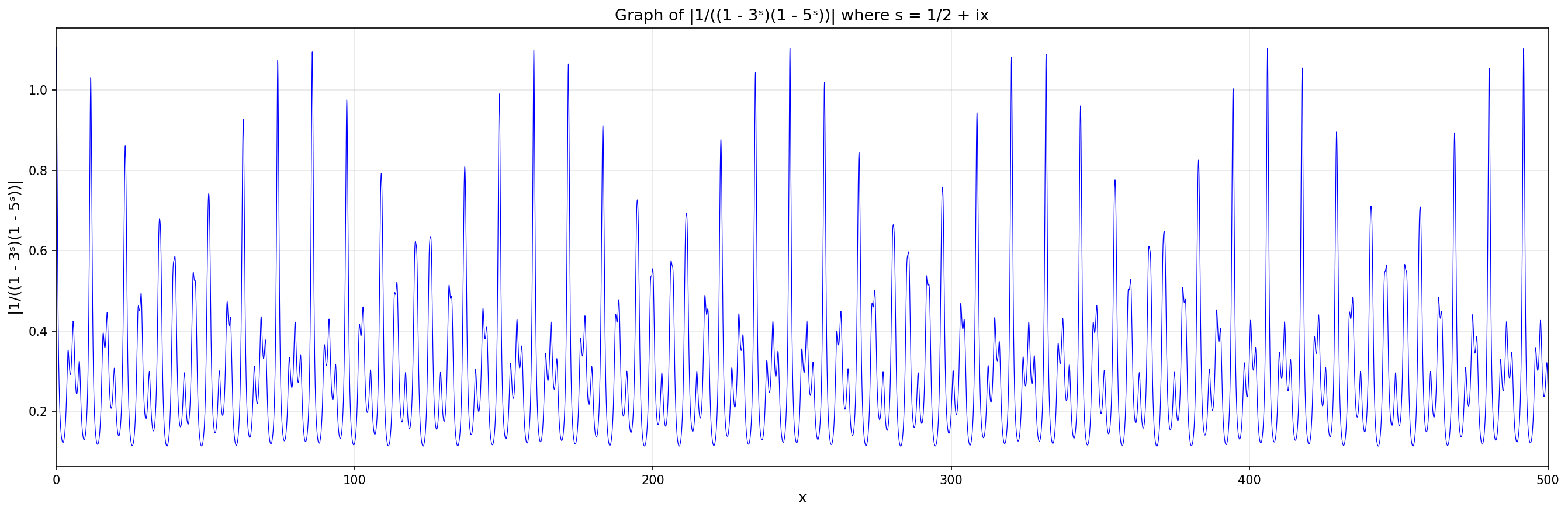
11.58 ≈ 5 × [2π/ln(15)]
The slow beating has a period of roughly
62.69 ≈ 27 × [2π/ln(15)]
I don't know if these approximate formulas are good - based on some deeper math - or just coincidences. With luck I can figure this out pretty soon, but I thought I'd throw it out here for y'all to play around with.
We can take the reciprocal of the zeta function and notice that
(1 - 3⁻ˢ)(1 - 5⁻ˢ) = 1 - √3 e^(ix ln 3) - √5 e^(ix ln 5) + √15 e^(ix ln 15)
So for *this* function we expect oscillations with periods
2π/ln(3) ≈ 5.719
2π/ln(5) ≈ 3.904
2π/ln(15) ≈ 2.320
but this does not instantly explain the longer periods that stand out so dramatically in the graph here.
(3/n)