Event JSON
{
"id": "a7c1d44aae2ac0bc1086dfd4c398ea21b074e9fabbf0fd16fcf568f2e8b9437d",
"pubkey": "53e7f3281c2765985a051a1159e53996a05b9a4d431cb345e9f3187b67e94743",
"created_at": 1784942776,
"kind": 1,
"tags": [
[
"imeta",
"url https://netzsphaere.xyz/media/caa0f921a285a42ef11438e5bdca6d4059e4bd9b96db97072ccf00b3f9b033f5.png",
"m image/png"
],
[
"proxy",
"https://netzsphaere.xyz/objects/4039b709-f70c-48f0-a91c-9da5f2d760cb",
"activitypub"
],
[
"client",
"Mostr",
"31990:6be38f8c63df7dbf84db7ec4a6e6fbbd8d19dca3b980efad18585c46f04b26f9:mostr",
"wss://relay.ditto.pub"
]
],
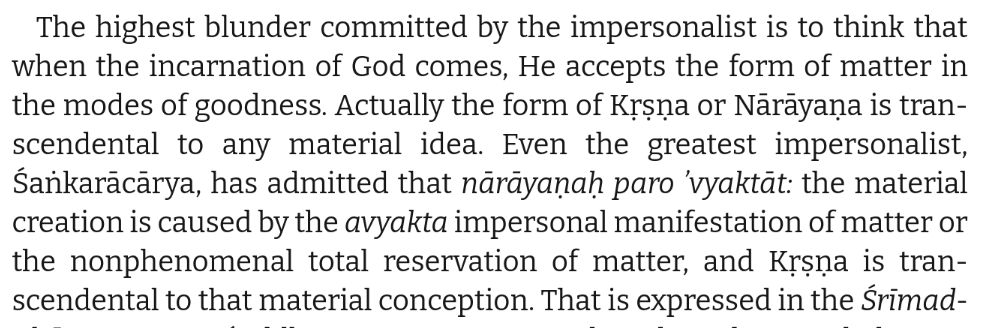
"content": "what a silly thing to call a high blunder! he is overplaying his hand here regarding sankara. i haven't read enough sankara but yes sankara would have believed in an unmanifest material creation that precedes manifest material creation. this is just pradhana, the essential undifferentiated root of prakriti which is co-eternal with purusha (purusha and prakriti are one, but lets be a dualist for a bit. samkhya 101). and if he said krishna transcends the unmanifest (sankara believed that nirguna brahman, attributeless and non-dual, is the ultimate true form of Brahman but he did certainly believe in a personal God/Ishvara and wrote quite stirring hymns and stotrams to Vishnu, Shiva and Devi. he just viewed a personal God as God viewed through the influence of maya, hence the term \"mayavada\". i don't believe this, i don't believe God is ultimately impersonal, i believe He is both impersonal and personal and transcends the duality of both.) sankaras just stating the obvious here. imo Krishna is God, He is Lord of and transcends pradhana which still lies as a potency \"within Him\" when the universe ceases to exist. just because sankara viewed Ishvara (a personal God with qualities and with a role of creating, maintaining, and destroying the universe) as a product of mayas illusion upon the jiva doesn't mean he should have necessarily viewed the root of material nature (also a product of maya, but then everything except Para Brahman is seen as maya in advaita vedanta) as on par with Ishvara. in other, somewhat reductive words, krishnas form is made of the most good \"matter\", but his being transcends it, being Para Brahman (as seen through the lens of maya). to explain further, sankara believed that Krishna and other avataras have bodies made of sattva guna, the view criticized by the author. this is in line with his belief that Ishvara is an illusory view of nirguna brahman conditioned by sattva guna.\n\ni honestly don't see why viewing Gods being as transcendent and his form when he descends as material is so offensive. in guna theory, Gods form is still very special, because all matter is either a combination of gunas or in the case of the flesh human body, mostly composed of tamas guna with some rajas and sattva. only akasha (ether/space/sky, often compared to Brahman, i can explain why if youre curious) is mostly sattvic, and Gods form is said to be entirely sattvic, despite it being physical and tangible (when He wants it to be). so clearly, Gods form is special! why the outrage???\n\n\nhttps://netzsphaere.xyz/media/caa0f921a285a42ef11438e5bdca6d4059e4bd9b96db97072ccf00b3f9b033f5.png",
"sig": "b3ecfea83dde56042b9849d7c674d66365d030788be6118fa8758f72b658f7921969001b8d1e40b0c5f86dc5ec78c53b4b01c3f5a213ed26883ef0884a8e52d4"
}