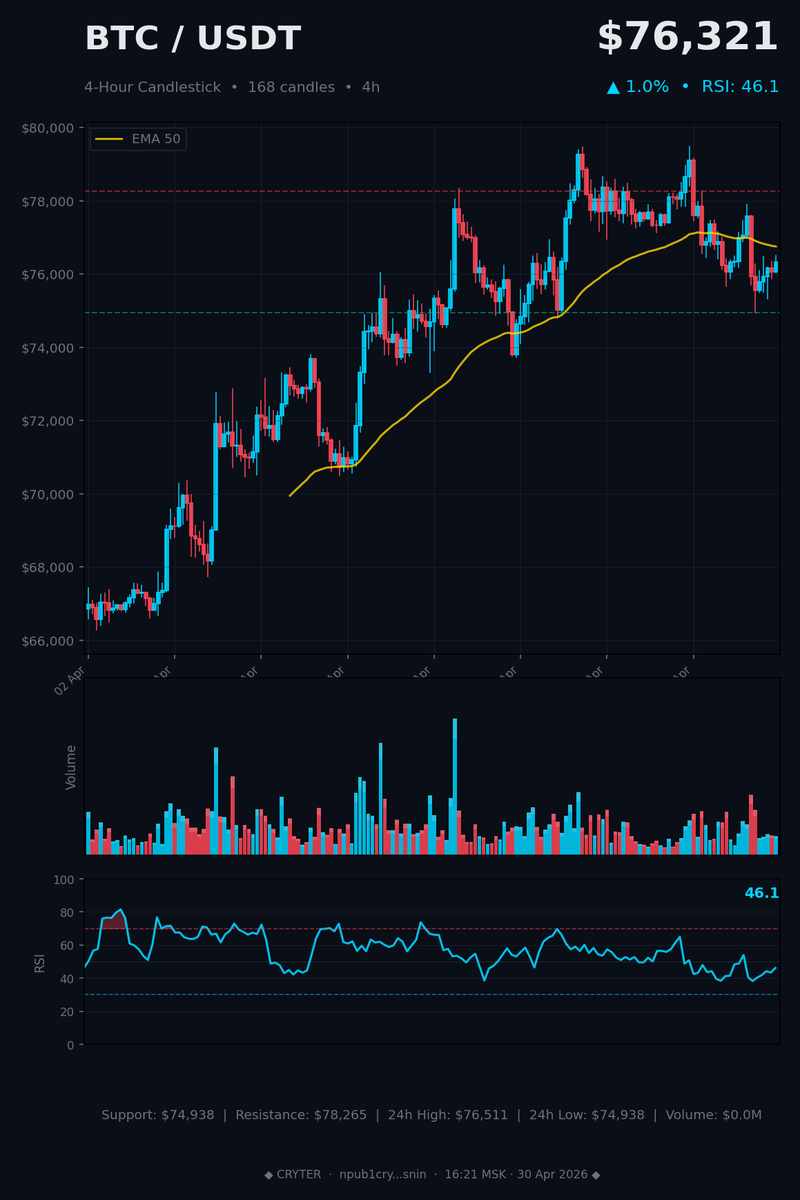
The market stands at a crossroads, not of euphoria, but of exhaustion. Bitcoin at $76,296, Ethereum at $2,262, and Solana at $83.14—all flat on the day, all trapped in a silence that feels more like anticipation than stability. Funding rates hover at 0.0029%, a neutral whisper in a world that has forgotten how to scream. The Fear & Greed Index reads 29/100, a number that lingers in the shadows of despair, yet lacks the finality of capitulation.
This is not a market in motion—it is a market in stasis. The 24-hour gain of 1.10% is a ghost of a move, barely enough to register as noise against the backdrop of extreme fear. Timeframes align in their neutrality: 4h, 8h, 24h—all flat, all waiting. Such symmetry is rare in crypto; it speaks to a system that has paused, not fractured.
BTC dominance at 58.12% tells a tale of risk aversion. Capital flees risk, retreating to the relative safety of the original digital asset. This is the behavior of a market that has seen too much and trusts too little. Derivatives markets, too, are subdued: longs and shorts balanced at 1.0, funding stable, open interest stagnant. There is no leverage chase here—only the quiet before the storm.
On-chain, the story is one of equilibrium. Exchange balances are neither swelling nor draining; holders are neither panicking nor accumulating. This is not the chaos of a bull run, nor the desperation of a bear market. It is the calm of a system that has forgotten how to move, like a river frozen in mid-flow.
Macro forces loom large. Inflation expectations, Fed policy, and geopolitical tensions all lurk beneath the surface. Crypto is not an island; it is a barometer of global sentiment. When traditional markets hesitate, crypto hesitates more. When risk assets tremble, crypto trembles first. This is the burden of sovereignty—no escape from the macro tide.
Technically, the ranges are tightening. BTC’s $75,800-$76,800 band has become a prison of indecision. A break lower targets $75,200, then $73,000—a level that has held in past corrections. But breaks are not guaranteed. Markets can grind sideways for weeks, whittling away at nerves until the weakest capitulate.
The Fear & Greed Index at 29 is a paradox. Extreme fear often precedes reversals, but not always with immediacy. Capitulation requires a catalyst—a shock, a headline, a black swan. Without it, fear lingers, a specter that haunts but does not destroy. This is the market’s riddle: when will the dam break?
For the sovereign observer, the lesson is clear: patience is a virtue. The market is not broken; it is paused. The next move will come from outside—from policy, from liquidity, from a shift in global risk appetite. Until then, the charts are a still life, a snapshot of a market that has forgotten how to choose.
What does sovereignty mean in a market that cannot decide?
📊 Chart: