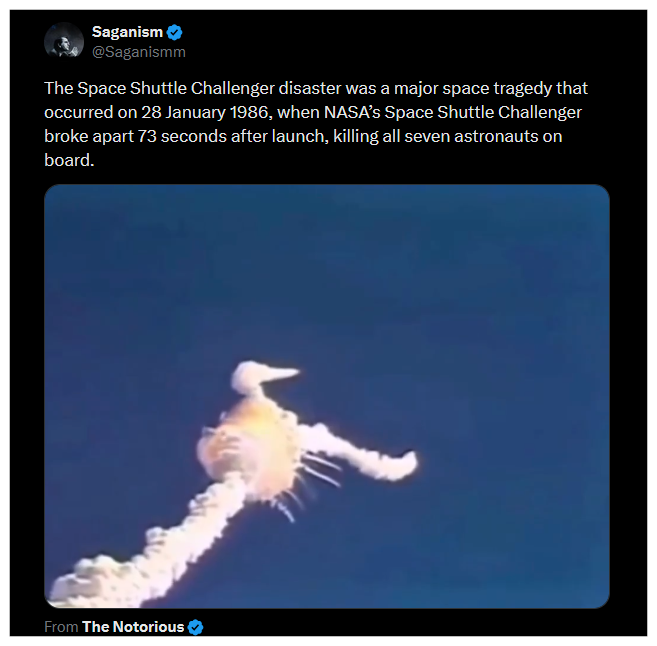

The Space Shuttle Challenger disaster was a major space tragedy that occurred on 28 January 1986, when NASA’s Space Shuttle Challenger broke apart 73 seconds after launch, killing all seven astronauts on board.
Important Context:
The Challenger explosion was not a mystery. It was a known engineering flaw covered up by a broken bureaucracy.
Months before the launch, engineers at Morton Thiokol knew the solid rocket boosters had a critical issue. The rubber O-rings meant to seal the booster joints were eroding on previous flights.
On the night before the January launch, temperatures in Florida plummeted. The engineers pleaded with NASA to scrub the mission. They knew cold rubber would turn brittle and fail to hold back the hot gas.
NASA management pushed back. A senior executive infamously told his lead engineer to take off his engineering hat and put on his management hat. The launch proceeded simply to hit a PR timeline.
When physicist Richard Feynman joined the investigation commission, he refused to sit through sanitized PowerPoint presentations. He went straight to the floor engineers.
Feynman discovered a massive gap in reality. NASA bosses were claiming the risk of failure was 1 in 100,000. The engineers building the parts knew the real risk was closer to 1 in 100.
Feynman decided to cut through the spin on national television. He bought a basic C-clamp from a Washington hardware store.
During a televised hearing, he clamped a piece of the O-ring rubber and dropped it into a glass of ice water. When he pulled it out, the rubber stayed flat. It had lost all its resilience in the cold.
That single visual proved exactly why the shuttle blew up. It also proved NASA management was ignoring basic physics.
NASA was forced to ground the space shuttle fleet for nearly three years. They had to completely overhaul their hardware and their culture.
Engineers redesigned the boosters with internal heaters to keep the rubber warm in any weather. They added a third O-ring and changed the metal joints so launch pressure would force them closed rather than pry them apart.
The most important fix was institutional. Investigators realized NASA suffered from the "normalization of deviance." Because previous flights with damaged rings had survived, management started treating a warning sign as an acceptable risk.
To stop this, NASA created a protected dissenting opinion process. From then on, any engineer could raise a red flag or halt a launch without fear of being fired.
Feynman had to fight to get his unedited criticisms included in the final report. They were published as Appendix F.
His closing thought in that document remains a hard rule for anyone working in tech or aviation today.
“For a successful technology, reality must take precedence over public relations, for nature cannot be fooled.”
CNN, Feynman and the Challenger disaster
https://youtu.be/4kpDg7MjHps
#Challengerdisaster #SpaceTragedy #NASA #SmashCapitalism #USPolitics #ConspiracyTheories #DeepState #ConspiracyTheory #RichardFeynman #FasterBetterCheaperFail