

Brasília Makes Friends With Beijing
https://fee.org/articles/brasilia-makes-friends-with-beijing/,
On a Sunday night in late July, Brazil's Luiz Inácio Lula da Silva and China's Xi Jinping spoke for more than an hour. It was cordial and faintly triumphant, with the two governments announcing their intention to accelerate https://www.scmp.com/news/china/diplomacy/article/3362042/brazil-turns-china-trade-deal-after-trumps-tariffs-years-resistance-end. Alongside this, there are plans to deepen cooperation on satellites and critical-minerals processing, and waive short-stay visa requirements.
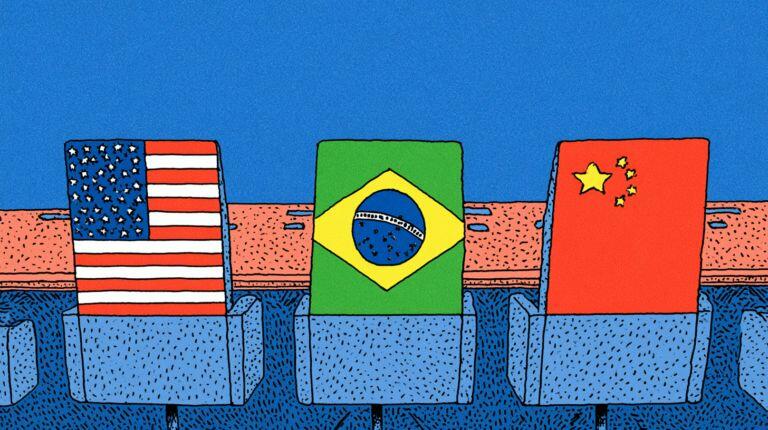
This marks a serious change for Brazil. For years, it was Brasília that https://www.scmp.com/news/china/diplomacy/article/3362042/brazil-turns-china-trade-deal-after-trumps-tariffs-years-resistance-end to exactly this sort of deal within the Mercosur bloc. The reversal was as sudden as it was shocking, taking only a fortnight to emerge, following a new American tariff taking effect and the Brazilian president deciding that the cost of alignment with the United States had, at last, exceeded its benefits.
Confronted with a United States that has moved from partner to antagonist, Brazil sees itself as neither retaliating in kind nor capitulating; it is hedging, deliberately, on several fronts at once. For many observers, this is a rational reaction to the emergence of an increasingly multipolar world. But just under a century ago, this practice had a name: "pragmatic equidistance." It was the way Brazil described its international strategy of balancing relationships with competing powers without committing to either.
The ongoing and escalating international trade war fueled by retaliatory tariffs has been the main catalyst here. In late July, a 25% tariff covering a broad range of Brazilian goods came into effect; per the Brazilian https://en.mercopress.com/2026/07/25/brazilian-industry-estimates-nearly-half-its-us-exports-will-face-additional-tariffs, nearly half of all Brazilian exports to the United States are now subject to some form of additional duty. Alongside the general tariffs, a "forced-labor" levy of 12.5% was introduced by the US to enforce bans on importing goods made with forced labor abroad, which in many ways represents a globalization of America's existing ban on Chinese goods using forced labor.
It is estimated that the hardest-hit goods carry a combined tariff of 37.5%.
President Lula's response has been to reframe the introduction of these tariffs as Washington's error rather than Brazil's, calling the tariffs a "https://www.washingtonpost.com/opinions/2026/07/26/lula-says-trumps-brazil-tariffs-are-strategic-mistake/"; in the Washington Post, and warning that the tariffs will drive Brazilian firms to replace their American suppliers with partners elsewhere.
The rhetoric is only part of it, though: Brazil has https://news.bloombergtax.com/daily-tax-report/brazil-files-complaint-with-wto-against-us-tariffs to challenge both the broad tariffs and the forced-labor levy as breaches of the 1994 General Agreement on Tariffs and Trade (GATT). The effectiveness of these consultations is up for debate given the WTO's general paralysis, but what matters more is what this reveals for Brazil's international-relations strategy: it is pragmatic equidistance on display. Brazil has filed the complaint with the WTO, while continuing negotiations with the US.
Meanwhile, Brazil is attempting to hedge its bets by engaging with the wider global economy. This month, https://apexbrasil.com/aboutapexbrasil (the Brazilian Trade and Investment Promotion Agency) has launched a https://www.freshplaza.com/north-america/article/9859230/brazil-to-launch-us-23-4-million-export-diversification-plan/ to support just shy of 2,500 exporters across 57 industries in their search for new markets, including the EU, Southeast Asia, and Central Asia.
Simultaneously, the Mercosur bloc is actively pursuing parallel deals with India, Japan, and Canada, with Brazil at the heart of this strategy. Lula has enacted the https://datamarnews.com/noticias/brazil-enacts-mercosur-singapore-free-trade-agreement/, the bloc's first with a Southeast Asian economy, under which Brazilian exports will progressively enter duty-free.
What is also interesting is what the imposition of these tariffs has meant for Lula at home. Many Brazilians read the tariff regime as https://www.wsj.com/world/americas/brazil-sees-a-trump-led-effort-to-tilt-election-against-lula-4eae7f55 that are due to take place in October 2026, which in turn has allowed Lula to https://apnews.com/article/brazil-lula-flavio-bolsonaro-foreign-interference-election-22cccc3135b09e2186898dd3cb394ed4 against foreign interference. This strategy has borne fruit: Lula's polling has remained steady in the mid-40s, while Flávio Bolsonaro-the only other major contender-has seen his popularity steadily decline since April 2026, https://en.wikipedia.org/wiki/Opinion_polling_for_the_2026_Brazilian_presidential_election#/media/File:2026_brazilian_presidential_election_polls.svg.
It may not have helped Bolsonaro that his presidential bid launch saw him https://www.aljazeera.com/news/2026/7/26/bolsonaros-son-begins-brazil-presidential-bid-with-netanyahu-milei-kudos, with few Brazilian politicians in the room. International campaigning is increasingly common, but in a climate skeptical of foreign interference, that move may have been more than a little tone-deaf, especially given the https://elpais.com/america/2026-07-28/milei-mas-que-un-conflicto-con-lula.html.
Not only this, but when the US sent election officials to verify the integrity of Brazil's electoral system, https://apnews.com/article/brazil-ambassador-milei-argentina-bolsonaro-43f2f81a3f51ccb35d5b143ae59ba756. For a public that is https://www.aljazeera.com/news/2026/7/23/us-tariffs-strengthen-lula-against-bolsonaros-son-in-upcoming-elections, this was a message that landed exactly in the way it was needed to.
Most notable, however, is Brazil's attempt to sidestep all of this via improved trade relations https://www.globaltimes.cn/page/202308/1296495.shtml. Of course, Mercosur is a customs union, and so all members must negotiate jointly-which is why a proposed China agreement has been formally https://aric.adb.org/fta/peoples-republic-of-china-mercosur-fta. In this, Brazil had been the brake, while Uruguay had spent years advocating for the trade agreement, and pursuing its own China talks whilst the other Mercosur members stalled.
https://www.malaymail.com/amp/news/money/2023/01/26/brazils-lula-says-urgent-for-south-american-trade-bloc-mercosur-to-seal-eu-deal-before-china-talks/51945 to argue that Mercosur should secure an EU deal first, and only then negotiate with China. With this deal https://newsonair.gov.in/eu-south-american-bloc-mercosur-sign-major-deal-to-create-one-of-worlds-biggest-free-trade-zones/-after 26 years of negotiations-and coming into effect in Brazil in April, the roadblock had been cleared. At least, on Brasília's end: Argentina's President Javier Milei is ideologically opposed to China, and will likely veto any deal pursued by Mercosur. China is already Brazil's largest trading partner, with https://www.riotimesonline.com/china-mercosur-trade-deal-accelerated-lula-xi/, and a deal could meet Brazil's other strategic interests, such as widening agricultural access.
Regardless, Brazil has been hedging its international trade relations with careful maneuvering, and in the long run, this may be the smart move.
https://cms.zerohedge.com/users/tyler-durden
Thu, 08/27/2026 - 22:35
https://www.zerohedge.com/geopolitical/brasilia-makes-friends-beijing

