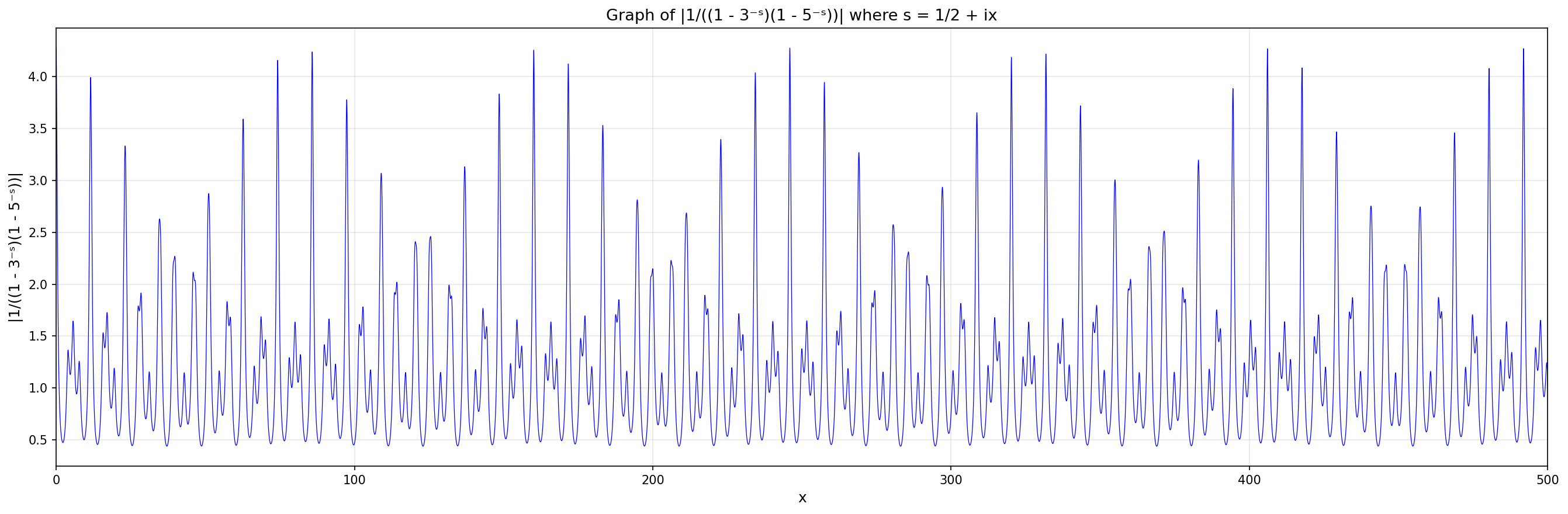

1/(1 - 3⁻ˢ)(1 - 5⁻ˢ)
arise because it's the product of two functions: 1/1 - 3⁻ˢ with period
2π/ln(3) ≈ 5.719
and 1/1 - 3⁻ˢ with period
2π/ln(5) ≈ 3.904
These functions both become big simultaneously when there are integers m,n with
m 2π/ln(3) ≈ n 2π/ln(5)
or in other words
m/n ≈ ln(3)/ln(5)
So finding the tallest peaks in the absolute value of the zeta function amounts to looking for good rational approximations of this number:
ln(3)/ln(5) ≈ 0.682606194
Here are the first few:
2/3 ≈ 0.6667
13/19 ≈ 0.6842
15/22 ≈ 0.6818
The first says we expect tall peaks spaced apart by roughly
2 × [2π/ln(3)] ≈ 3 × [2π/ln(5)]
These numbers are close but not equal! Look at them:
4π/ln(3) ≈ 11.44
6π/ln(5) ≈ 11.71
This explains why I empirically found that the very tall spikes in the graph below are separated by a distance of about 11.58. However, my guess that this distance is really
5 × [2π/ln(15)] ≈ 11.6009
may be completely wrong.
(4/n)